UX/Product Design

Wawa Go


Rediscover the city

A mobile app helping Warsaw residents break out of their daily routines and discover what their city has to offer, filtered by weather, budget, and interests.

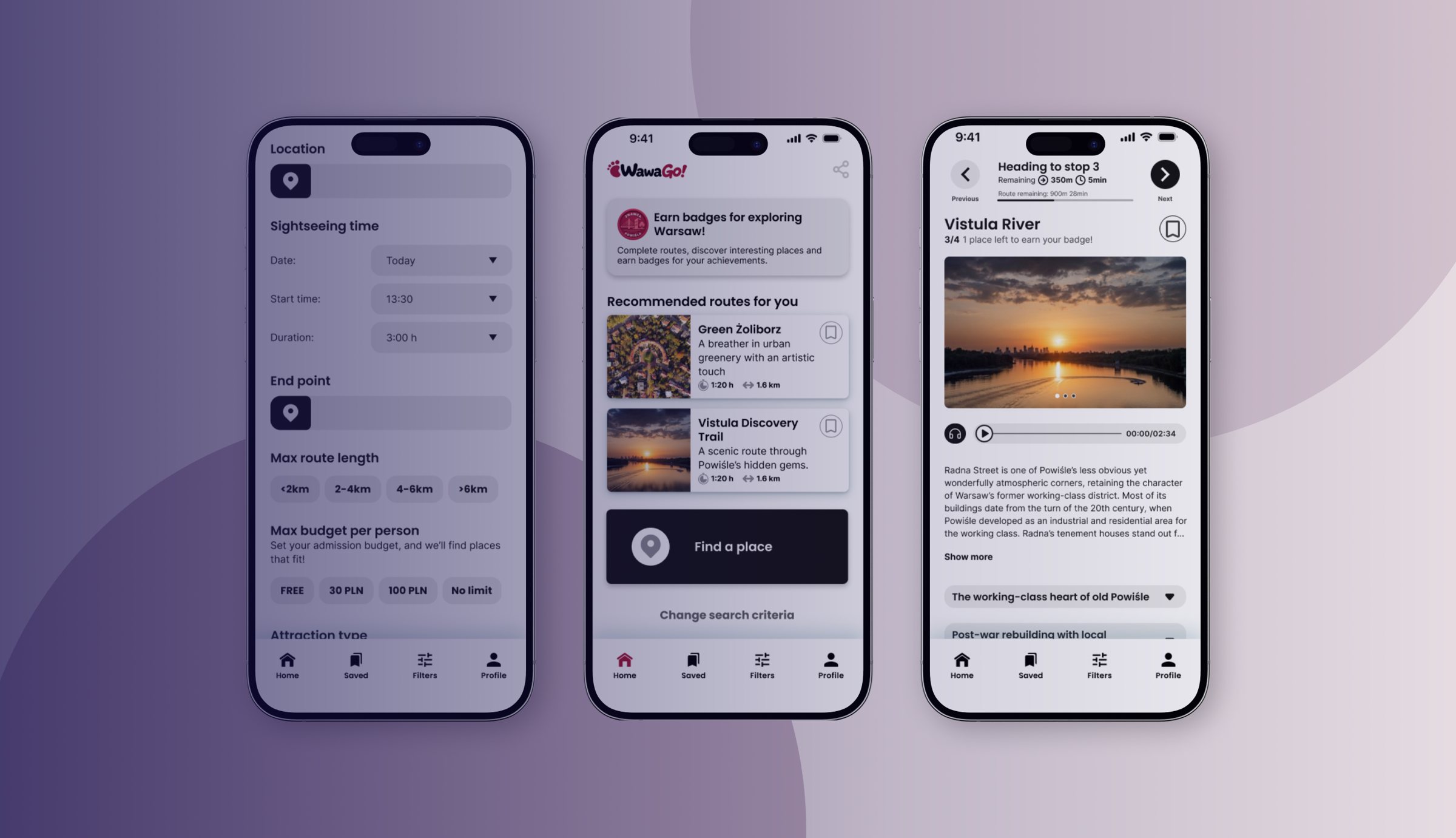
Wawa Go app screens

Project Overview

Helping Warsaw residents rediscover their own city.

I led a four-person student team and was involved across the full UX process, from research synthesis and product strategy to user flows, prototyping and usability testing. I also coordinated the team's work and helped translate research findings into product decisions.

Role: UX Designer | Project Leader
SWPS University Warsaw 2025/2026

Scope

Problem definition User research & synthesis Strategy Scenario development Core user flows Prototyping Usability testing Iterating

The Problem

We know our city so well, we stop seeing it.

We get used to following the same routes – to work, home, the shops – and rarely have a reason to take a different street or explore what lies just around the corner.

The problem isn’t a lack of interesting places. It’s that discovering them requires an extra effort: information is scattered, recommendations are often tourist-focused, and finding a good idea can take more time than we want to spend planning.

RESEARCH

*This case study presents selected, condensed data from the full sources.

Desk Research

90%

of Warsaw residents see the city as dynamic, with a lot going on

39%

took part in cultural, educational, or artistic events in Warsaw over the past 12 months

54%

explored cultural events available in their neighborhood

Data from Statistics Poland (GUS), the Public Opinion Research Center (CBOS), the Strategy and Analysis Office of the City of Warsaw, and the City Marketing Office.

Qualitative Research

10 in-depth interviews with Warsaw residents aged 20–50.

Research Objectives and Questions

Our goal was to understand people who explore and discover the city and develop recommendations for a solution that makes this easier in a modern and engaging way.

RESEARCH QUESTIONS:

  • What do people who explore, discover, and sightsee in the city expect? What do these concepts mean to them? What kind of time / day would they like to spend out in the city?
  • What experiences and habits do they have related to exploring and discovering the city? How do they spend this time, with whom, what helps them?
  • What emotions do they experience when discovering the city? What matters to them?
  • What gets in their way or frustrates them when planning activities in the city and during those activities?

Key Findings

The research revealed that discovering a city is shaped by more than places and attractions. People seek meaningful experiences influenced by their mood, company, and circumstances. While their approaches to exploration vary, fragmented information and planning challenges can make discovering something new unnecessarily difficult.

01

Experience over attractions

People seek atmosphere, authenticity and a sense of discovery.

02

Company shapes the outing

Who people go with matters as much as where they go.

03

Different planning styles

Exploration ranges from carefully planned to fully spontaneous.

04

Rediscovering the familiar

Residents want to explore both their neighborhood and unknown parts of Warsaw.

05

Fragmented information

Users rely on multiple sources to find and verify places.

06

Context matters

Weather, time, budget, crowds and family needs shape decisions.

Behavioral Profiles

Additional

Core Insight

The purpose of a walk isn’t the destination,
but the places and experiences along the way.

Product Strategy

01 - Users

Main problem: chaos in planning

Planning an outing is time-consuming and scattered across multiple sources. Barriers include: lack of time, information overload, difficulty planning, weather, uncertainty, and fatigue.

02 - Competition

Product USP

Personalization and recommendations for “off-the-beaten-path” places, with advanced filters: budget, weather, time of day, and tourist traffic levels.

03 - Development

MVP

Personalized route and place suggestions based on weather and time of day, saving favorite routes, notifications about interesting places along the route.

Additional

DESIGN

Design Decisions

How might we make discovering Warsaw feel effortless, personal and worth leaving your usual route for?

01

Fewer choices upfront, personalization that grows with use

We moved detailed preference questions to a later stage to keep the first-launch experience light. Personalization remains central to the product, but users reveal their interests, mood, time and budget gradually, when this information becomes relevant — instead of completing a long survey before seeing any value.

02

Complete, ready-to-use routes built from scratch

We considered letting users add places to an existing route, but chose full route creation instead. Each route is generated as one coherent whole, turning scattered inspiration into a plan users can follow immediately without searching across multiple sources.

03

Suggestions that fit real life and go beyond the obvious

Recommendations adapt to weather, time of day and crowd levels, so they make sense in the moment. At the same time, we prioritize lesser-known places, local stories and nearby discoveries to help residents rediscover Warsaw beyond the usual tourist routes.

Selected Flows

01

Personalized Route Discovery

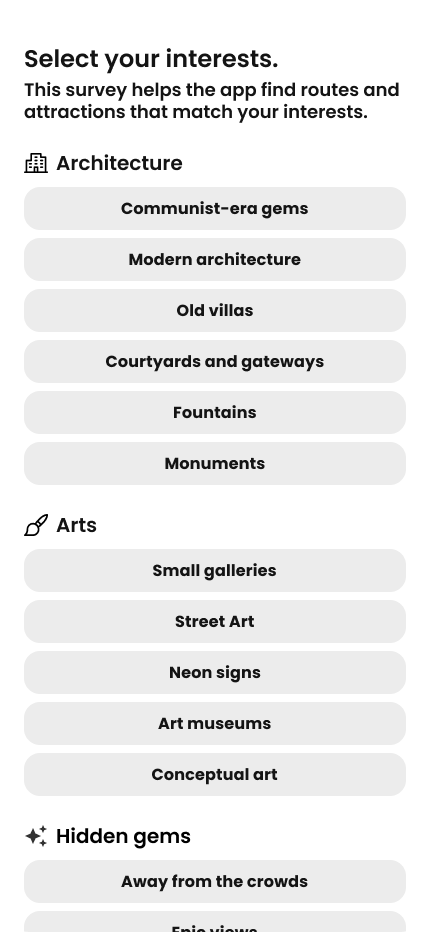
Initial survey screen
1

Initial survey

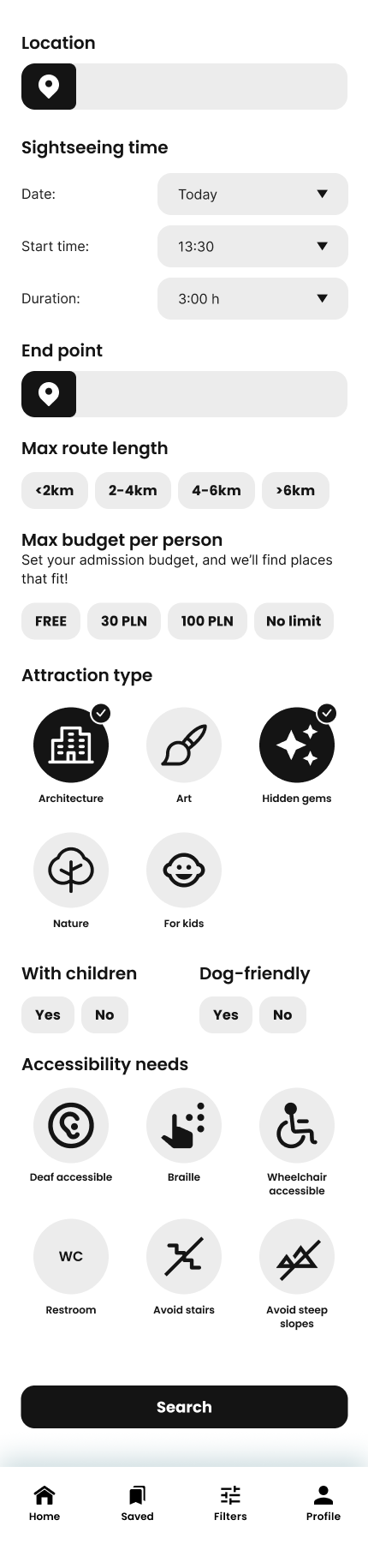
In-depth survey screen
Scroll ↓
2

In-depth survey

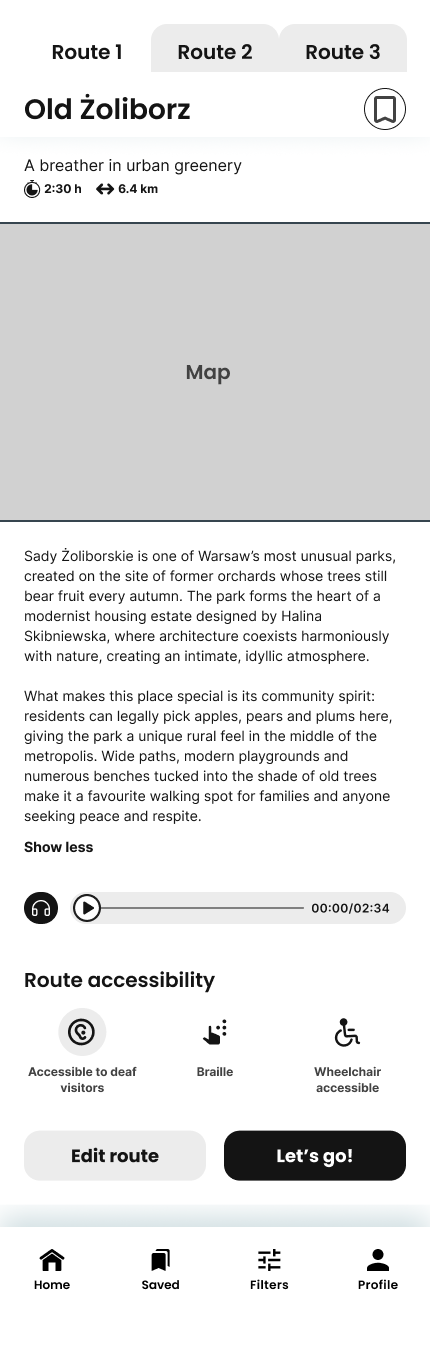
Personalized route suggestions screen
Scroll ↓
3

Personalized route suggestions

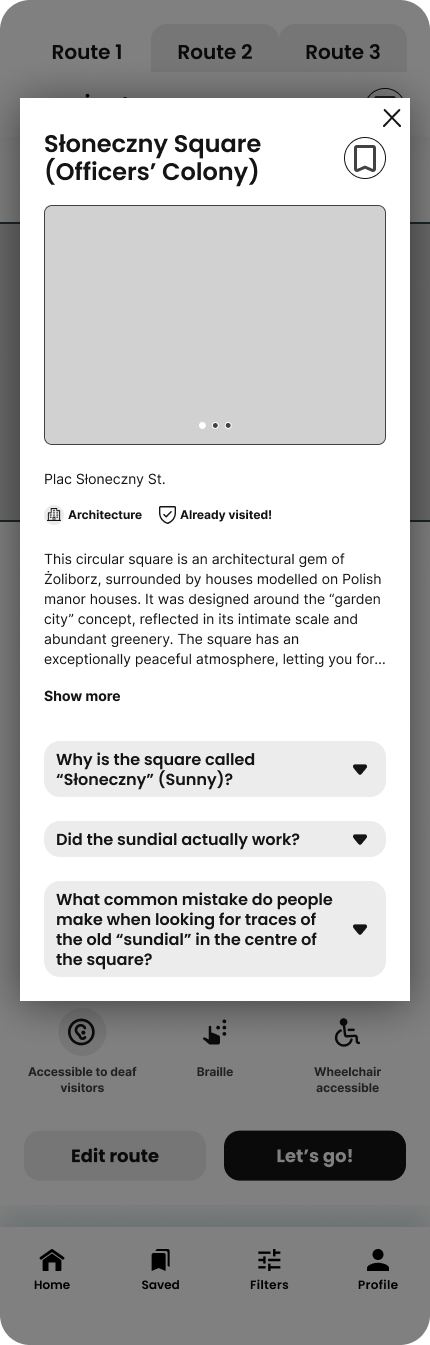
Route element preview screen
Scroll ↓
4

Route element preview

Users can discover personalized routes based on their interests, available time, budget, and current conditions. Instead of searching for individual attractions across multiple sources, they receive ready-to-explore suggestions that combine interesting places into a cohesive experience.

02

Gamification

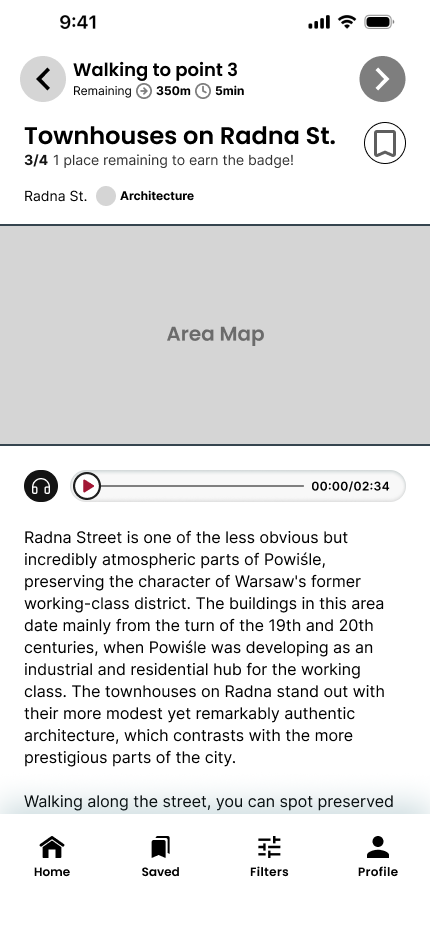
Route in progress screen
1

Route in Progress

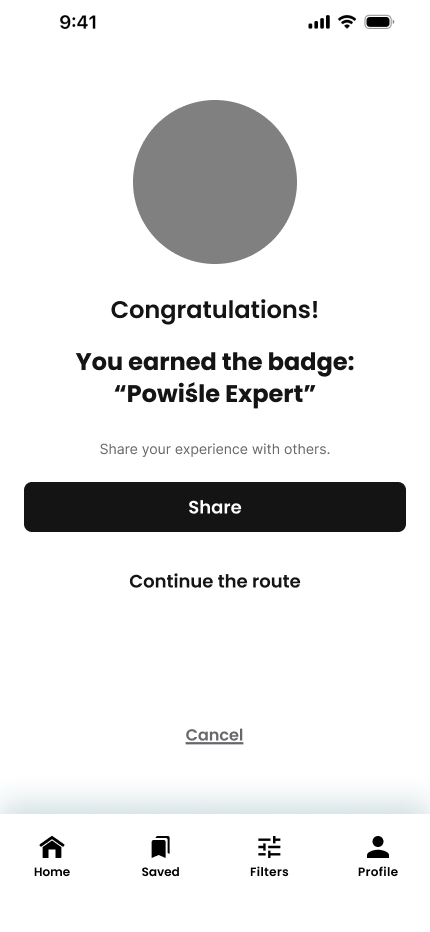
Badge earned screen
2

Badge Earned

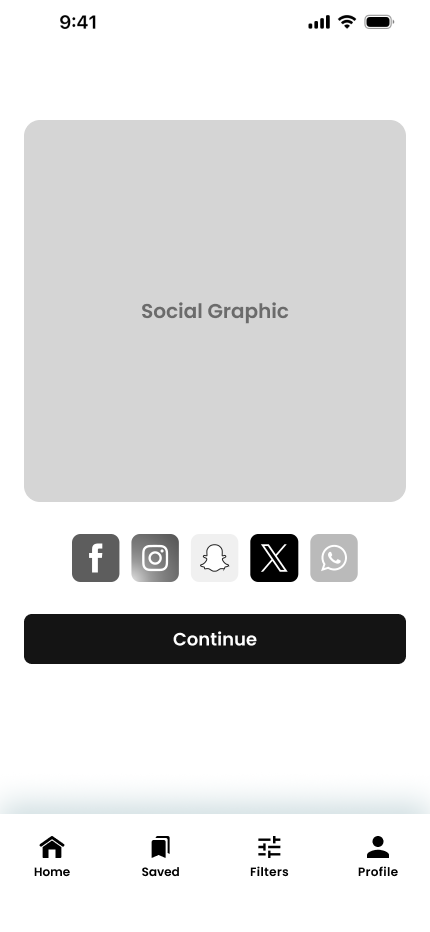
Share achievement screen
3

Share Achievement

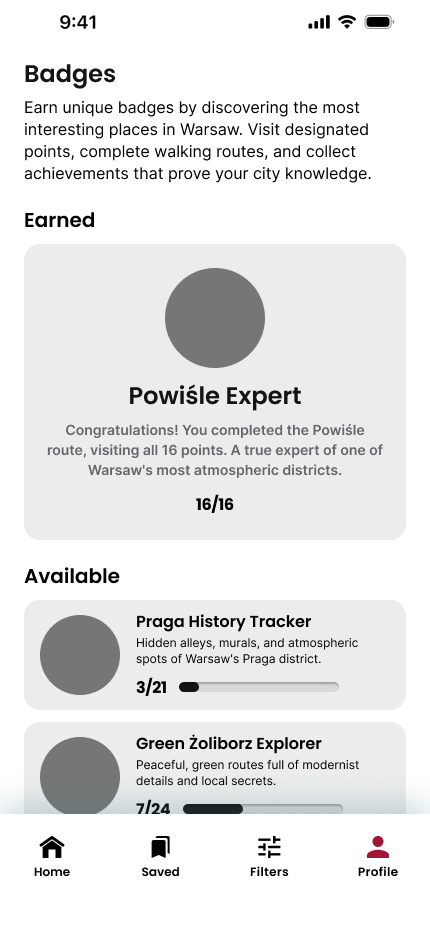
Badge collection screen
4

Badge Collection

Gamification was introduced as a supporting engagement feature. Users could earn badges for completed routes and explored districts, creating a stronger sense of progress and discovery. The concept was received very positively during testing.

03

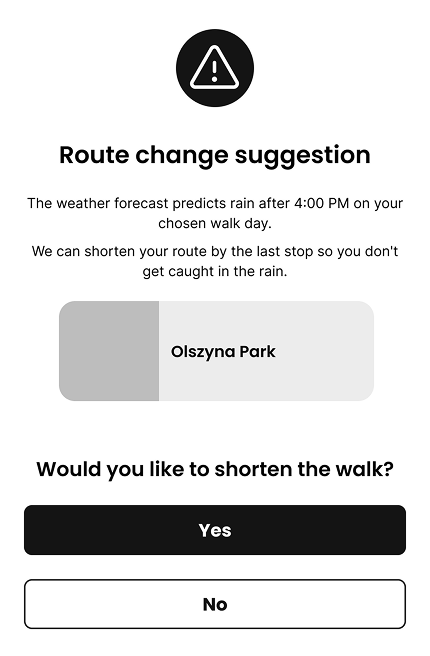
Route Changes Due to Weather

One of the key design flows in the app is weather-aware route adjustment. The app monitors weather conditions and adapts the planned route accordingly.

For example, if rain is expected at 2 PM, the app can warn the user that a walk through the park may no longer be the best option and suggest adjusting the route.

Route change suggestion pop-up

Iterations

We tested selected user flows to evaluate navigation, information hierarchy, and feature relevance. Feedback helped us identify usability issues, challenge initial assumptions, and refine key interactions. The following examples highlight three design decisions shaped by testing.

01

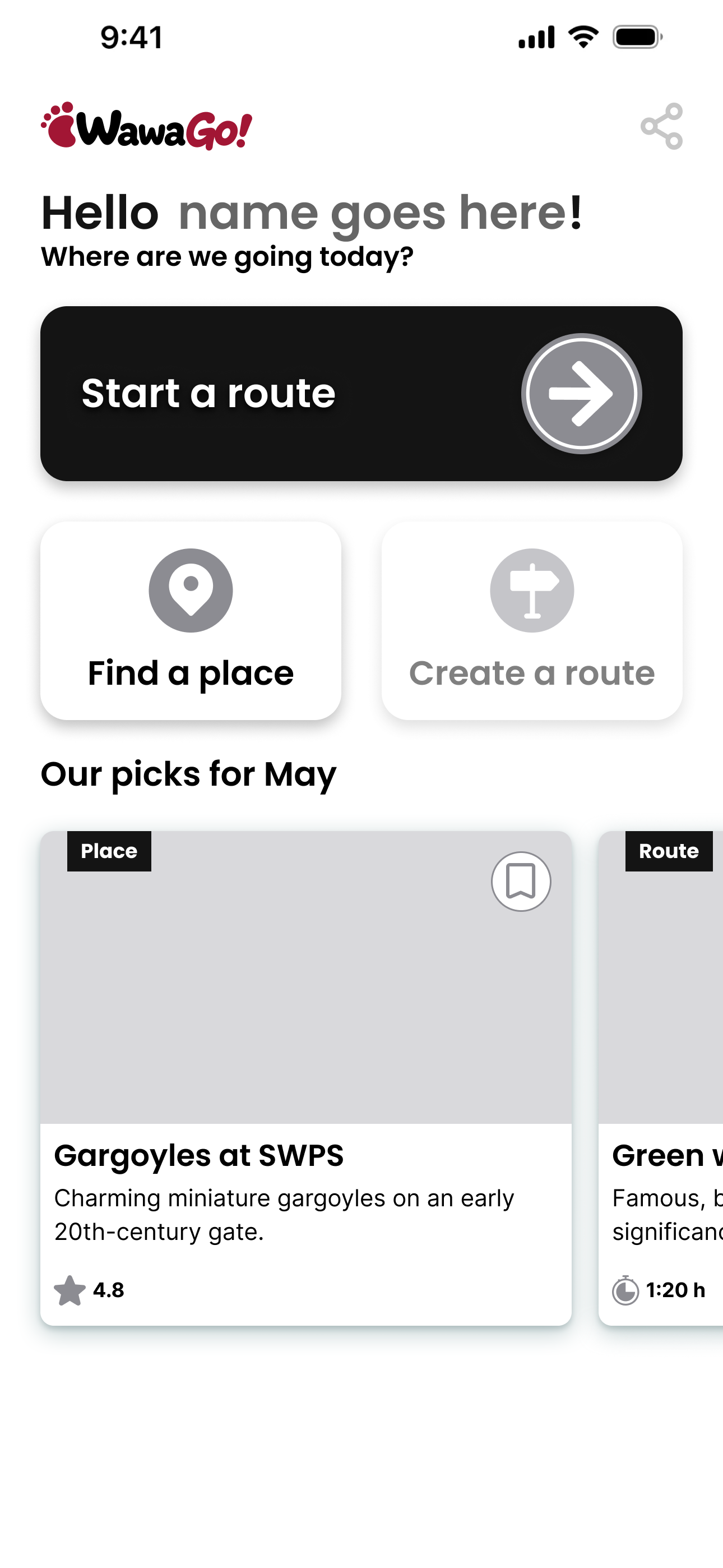
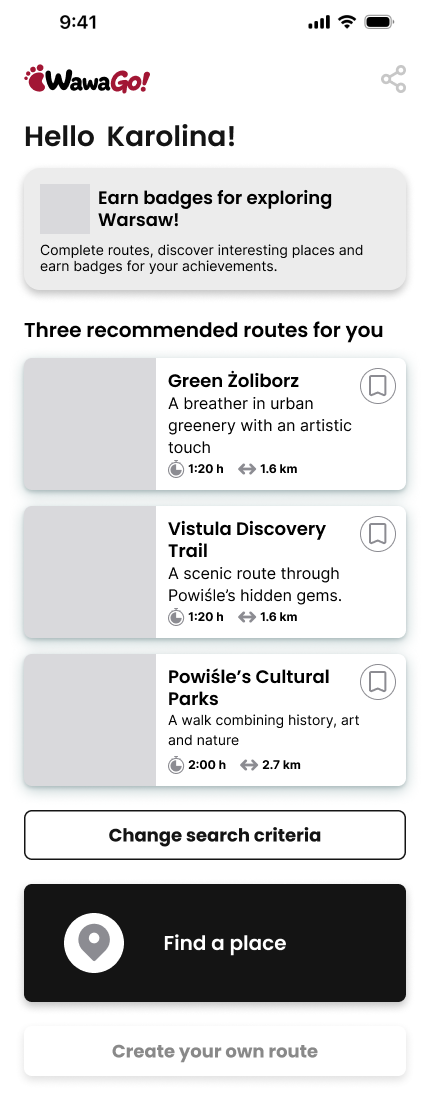
Home Screen

What we learned
Users struggled with the hierarchy of the home screen and often missed the main CTA.
What we changed
We removed distracting secondary content, moved the map, and prioritized personalized route recommendations.
Additional insight
Badge-related gamification attracted strong user interest, so we made it more visible in the interface.
Before
Home screen — before testing
After
Home screen — after testing
Scroll ↓
02

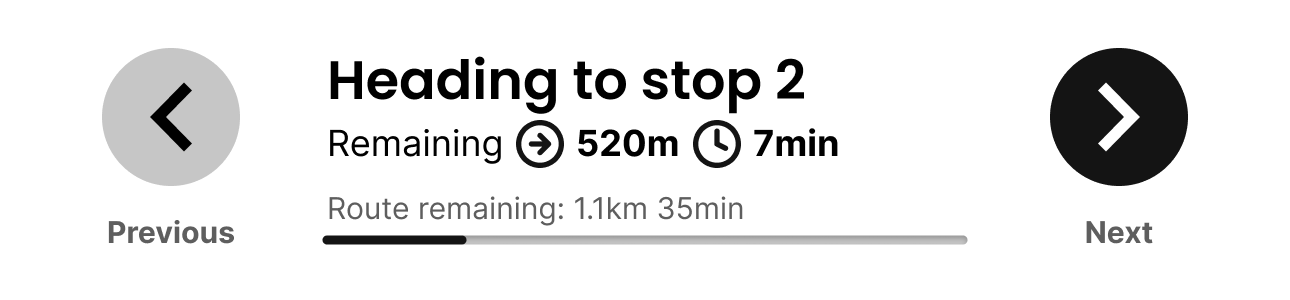
Route Header

What we learned
The route header was unclear and difficult to navigate.
What we changed
We simplified the layout, improved information hierarchy, and added clear distance, time, and progress indicators.
BeforeRoute header — before
AfterRoute header — after
03

Place Rating

What we learned
The first iteration showed that users found the rating flow intrusive. The second revealed a deeper issue: the rating itself did not feel meaningful, and a 5-point scale oversimplified the experience.
What we changed
We first reduced the feature to an optional element within the place card. After the second round of testing, we removed the rating system entirely.
BeforePlace rating — first iteration
After round 1Place rating — second iteration
After round 2Rating removed

*This case study highlights three selected iterations only. The full design process involved many more rounds of testing, refinement, and detailed analysis.

Outcome and Conclusions for the Future

01

Create Your Own Route

One of the most promising ideas that emerged during testing was the ability to create custom routes.

Although the feature remained a concept rather than a fully developed flow, users immediately recognized its potential, from planning personalized walks to creating routes as gifts for friends or family. Further development could explore a simple route builder that lets users select places, arrange stops, and save or share their own itineraries.

02

Gamification – Make Badges Matter

The badge system was received positively, but users expected a clearer sense of progression.

I would introduce district-based exploration challenges, where users earn their first badge after visiting three places, then unlock new milestones by completing themed routes and exploring different neighborhoods. A visual progress tracker would make achievements feel meaningful and encourage real-world discovery rather than simple in-app interactions.

03

Simplify Onboarding

For future development, I would recommend simplifying the current onboarding flow. The existing questionnaire asks users a long series of questions about their interests, preferences, and travel habits, making the experience feel more like a form than the beginning of exploring Warsaw.

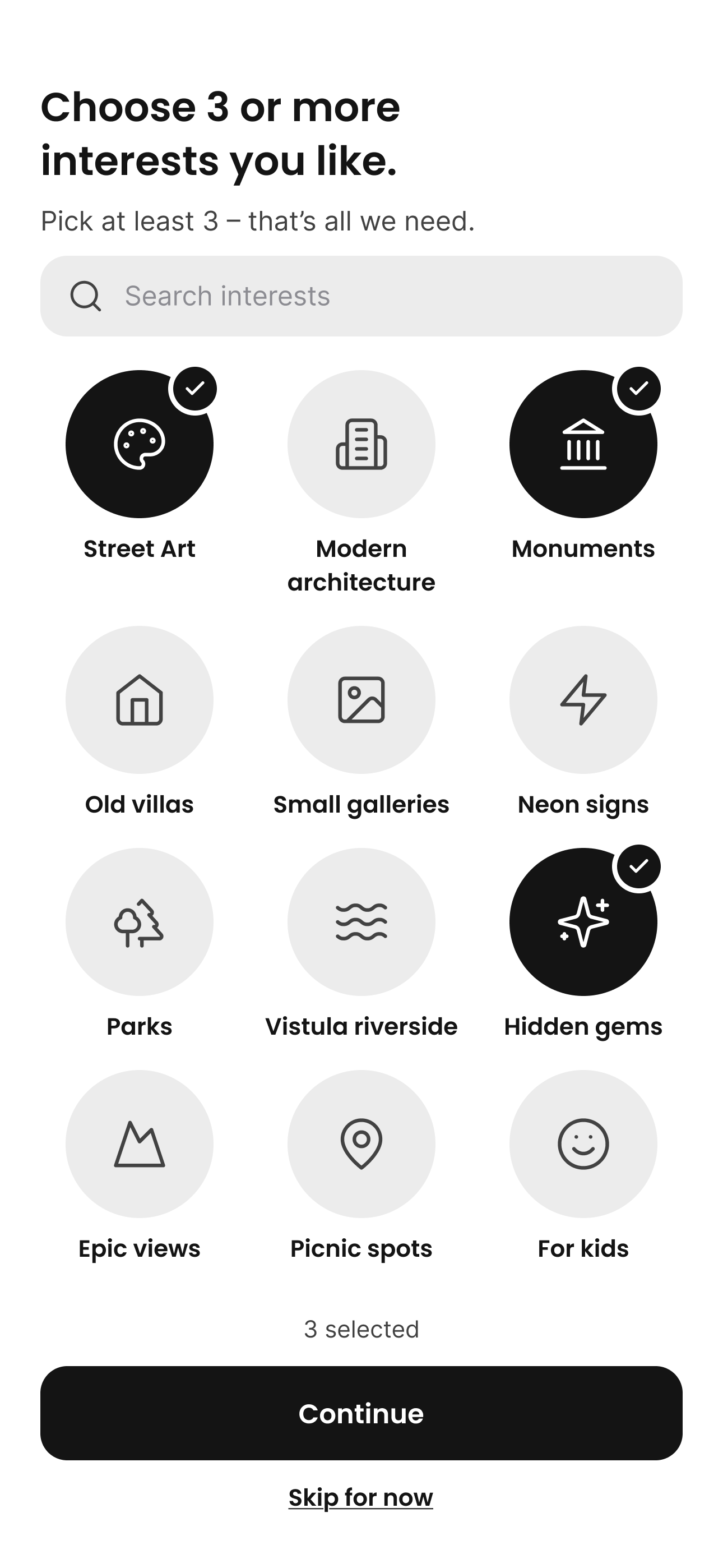
A stronger direction would be a lightweight, visual flow inspired by Spotify’s “choose your artists” experience. Users could select at least three interests, such as history, cafés, parks, street art, or architecture, from a simple visual grid, giving the app enough information to personalize recommendations immediately.

The main benefit would be a much shorter path to first value. Users could reach a personalized home screen within seconds, while deeper preference settings could remain optional and be refined later in the profile.
Current onboarding survey
Proposed visual interest picker

What Didn’t Work

01

Drift from the Original Vision

As the project evolved, we became increasingly focused on guiding users through the city, refining mechanics, screens, and interaction flows, particularly through multiple iterations of the home screen.

In the process, we partially lost sight of the original ambition: to create a product that would feel meaningfully different from tools such as Google Maps or TripAdvisor. The final concept still requires further iteration to deliver a truly distinctive market value proposition.

02

Dependency on Unique Content and Data

One of the biggest challenges for real-world implementation is the app’s reliance on a large, high-quality, and unique database of places and stories. The product cannot simply depend on existing sources such as Google Maps or TripAdvisor if it is to maintain its distinctive character.

Building such a database, potentially in cooperation with partners such as the City of Warsaw, local guides, or cultural institutions, would require significant research, content creation, and ongoing maintenance. This dependency was not sufficiently addressed at the beginning of the student project and should have been treated as a key product constraint much earlier.

03

Scope and Process Limitations

As a student team, we initially approached the project with a very broad scope and limited experience in managing product complexity. Our process was more waterfall-oriented than iterative, which made it harder to validate assumptions early and adjust priorities as new insights emerged. A more agile approach, with smaller experiments, earlier validation, and clearer prioritization, would likely have helped us stay closer to the core value proposition and reduce unnecessary iterations.

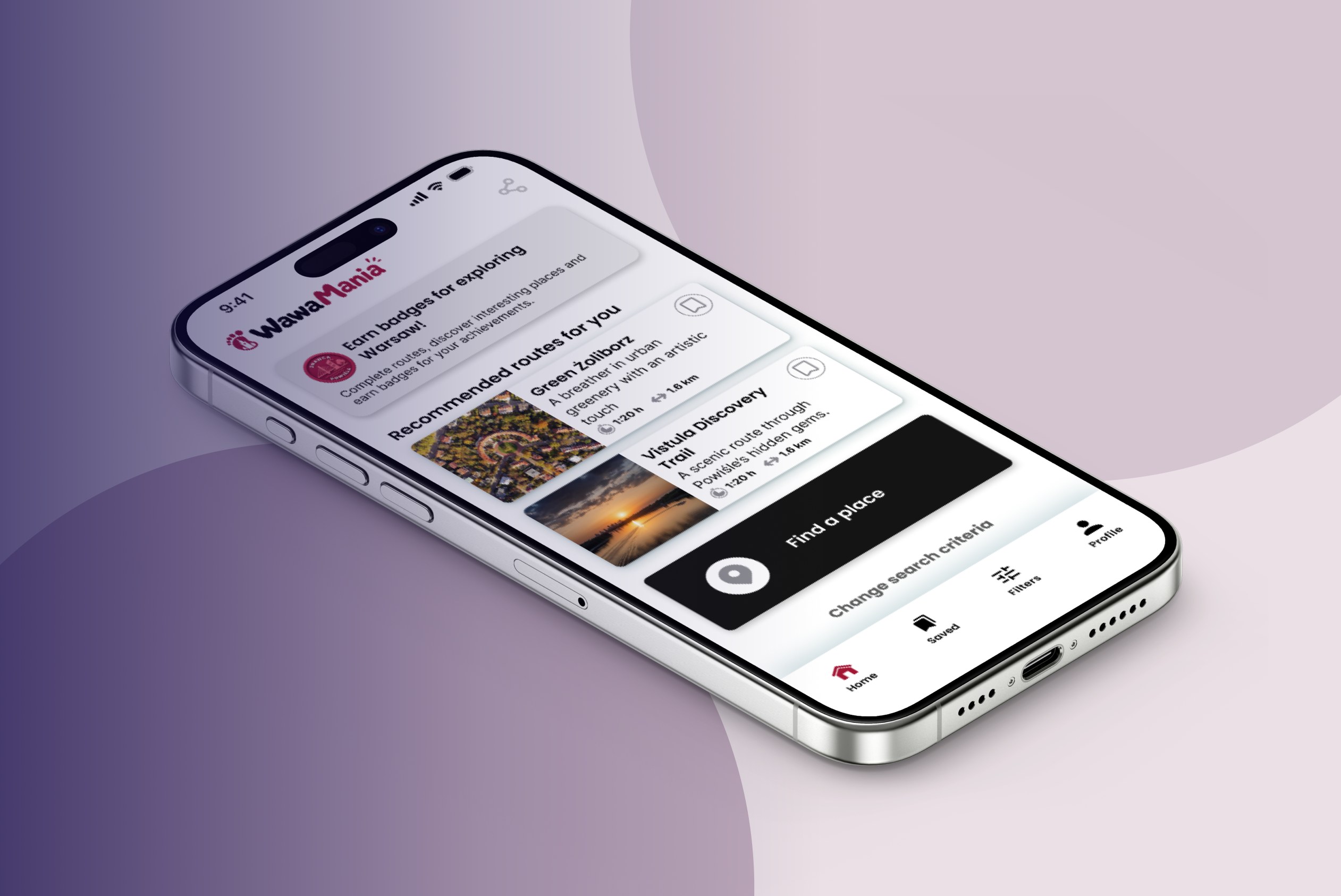
Wawa Go app on a phone

Final Reflection

The project ended as a student concept, but not as a fully resolved product. Its biggest challenge was scope: we tried to solve too many problems at once and did not validate every assumption early enough.

What remained strong, however, was the core opportunity: making local discovery more personal, contextual and effortless. With a narrower focus and further iteration, the concept could evolve into a much more distinctive product.

Back to projects

Contact

Have a project in mind?

barbara.m.siwek@gmail.com